Berlin, Under Construction
Status: Public civic information prototype · public pages checked 28 September 2026
My role: Product direction, visual design, information hierarchy, evidence workflow and publication scope
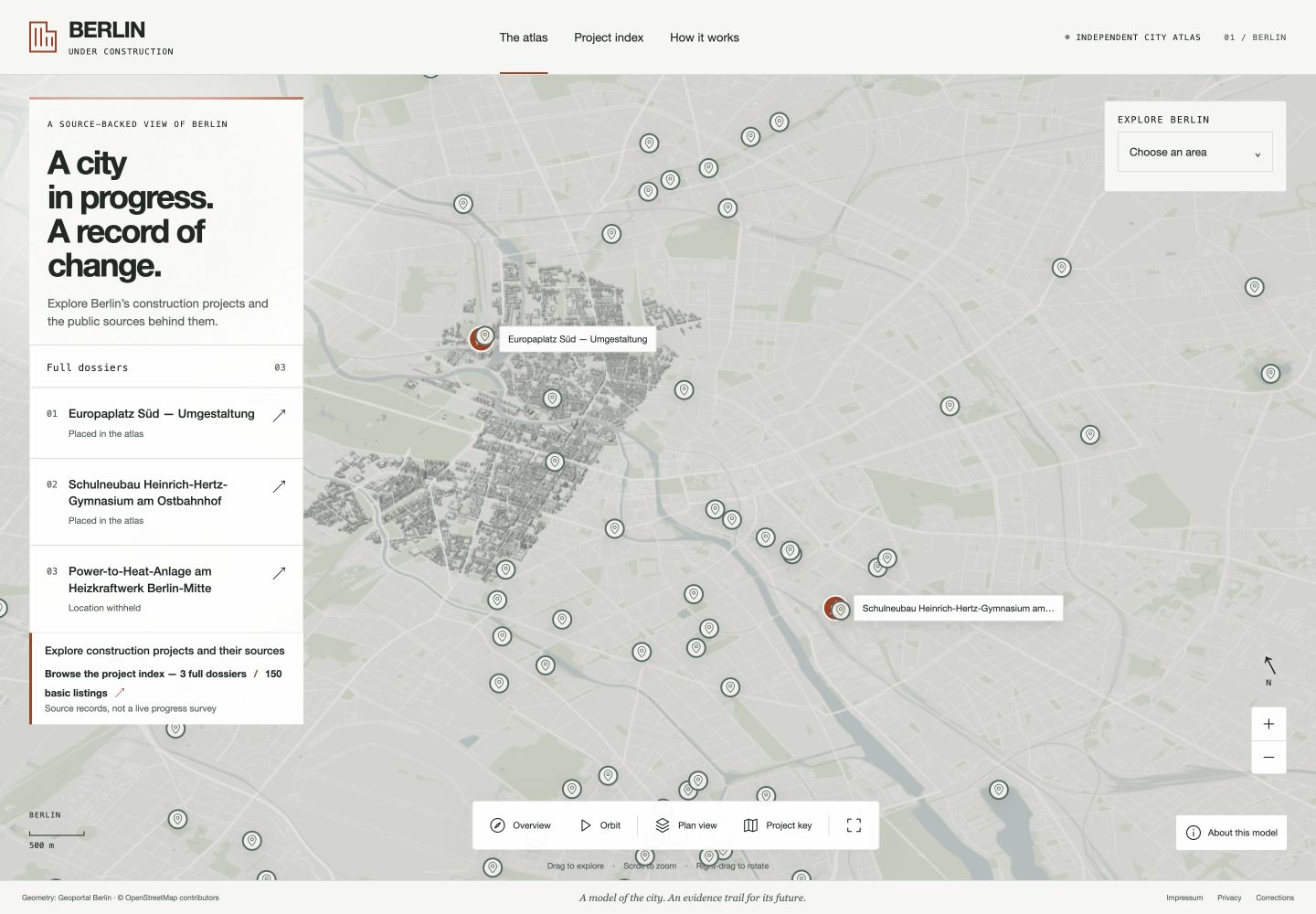
Local interface refresh, 26 September 2026. The public atlas and project index were checked on 28 September; these screenshots show the newer local design.
Why I made it
Construction would go up in Berlin, and I’d have no idea what was happening, how long it would be there, or when it was supposed to be finished. Sometimes it would eventually disappear, and I still wouldn’t really understand what had been done.
I figured I should be able to look this up online. But the information was scattered across different sources. I thought, how useful would it be if residents and government officials could open one place, click on a project, and follow the information back to its source?
What I wanted it to do
Pretty simple: click on a construction site and see what the project is, how long it’s been going on, whether it’s on time, how much it costs, and when it should be done.
That’s the ambition. The current prototype brings together basic listings and a smaller set of reviewed project records. Where information is missing or conflicting, it keeps that visible.
What I found interesting
One of the most interesting challenges was working with German documents as an English speaker. I had to work through the terminology and develop a glossary to help interpret the records consistently. Having a German speaker review the documents and glossary would help close that gap.
This project helped me see how I could contribute to work in the German market while working primarily in English.
My contribution and the workflow
I shaped the product, interface and publication scope, reviewed source passages for the three original dossiers, and worked with AI agents on research, implementation and testing. The workflow preserves original German passages and makes the need for language review explicit.
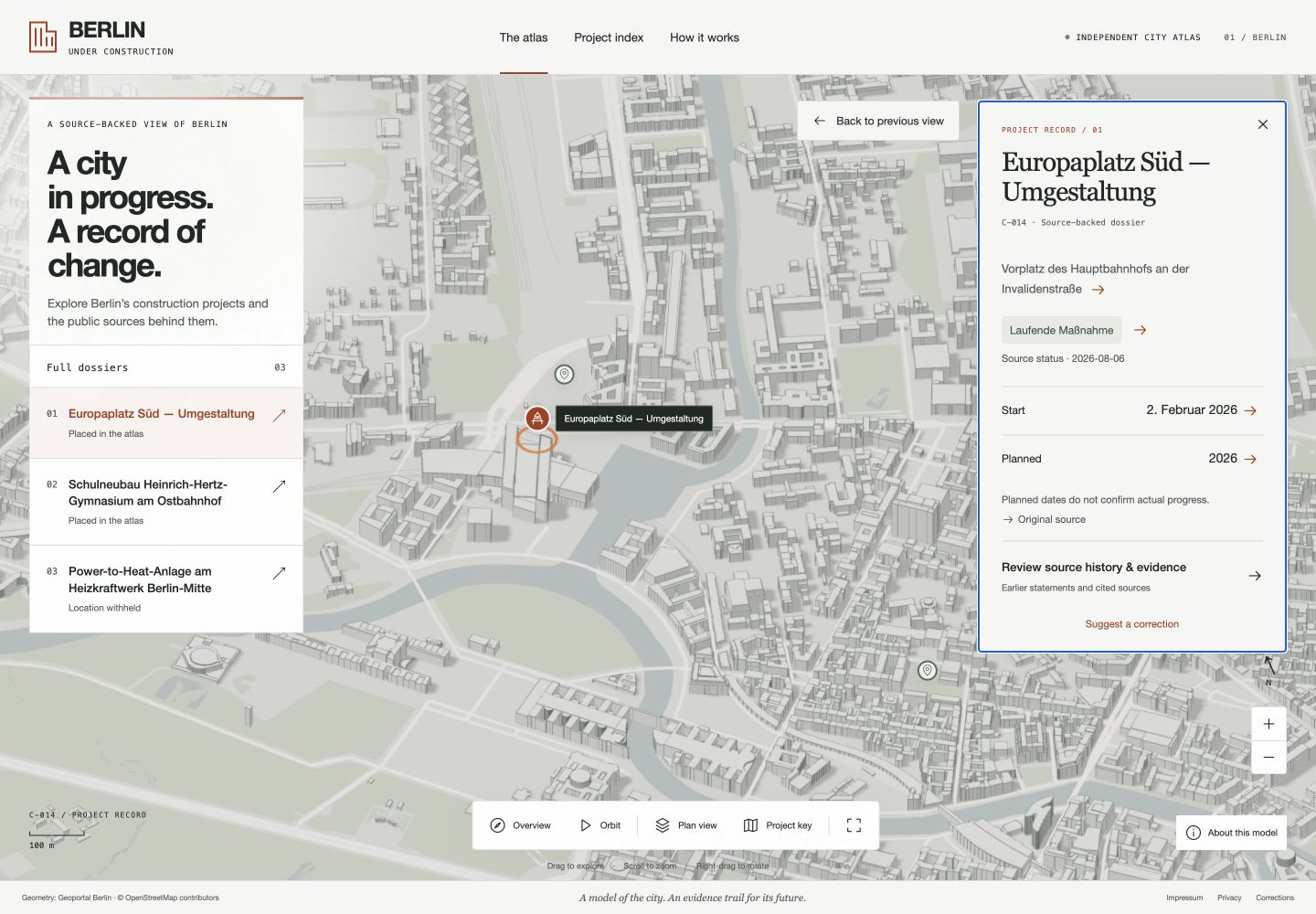
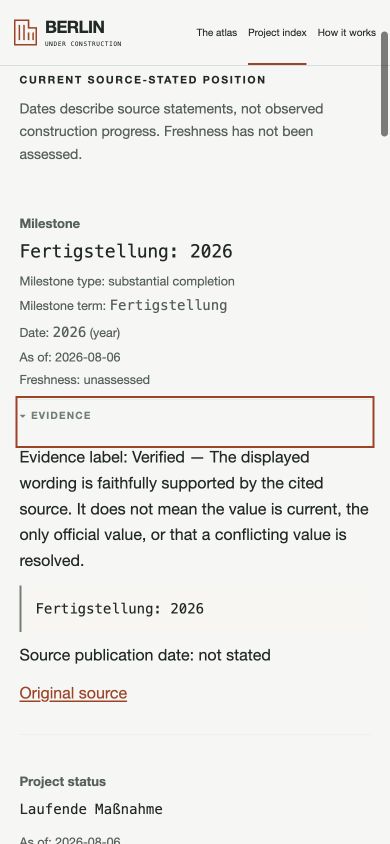
The reader selects a project, opens its overview, expands a dated evidence field, and follows the original source. AI agents helped find records and propose structured extractions. Human review determines what can be published; unsupported fields stay missing.
The decision: coverage without false confidence
The atlas offers 150 basic listings and three reviewed dossiers, with only two of those dossiers positioned on the map. Listing reference points are not surveyed site boundaries. Architectural geometry helps readers orient themselves; it does not show construction progress.
That distinction gives the map useful breadth without pretending every marker has the same research depth. The energy dossier has no pin because its location is withheld. Europaplatz retains competing financing statements instead of presenting one settled total.
Technology, verification and limits
The project combines a Python evidence pipeline, Astro/TypeScript interface and Three.js map, implemented with AI assistance under my product direction.
On 28 September 2026, I checked the public atlas and project index: the index exposes 150 basic listings and three reviewed pilot records, with two pilot locations mapped and the energy location withheld. The public interface differs from the newer local screenshots shown here. This check does not establish that the local refresh is deployed.
On 21 September 2026, the project agent recorded 207 passing tests and a passing TypeScript check, plus desktop and 390px browser walkthroughs. It verified the existing public release across 14 HTML routes. These are checks of software behavior and publication consistency, not an AI extraction-accuracy score.
The public source revision checked was 57c1e68. The engineering checks refer to the newer local revision 2a1e6f3; the agent’s verification of the published release did not refresh every construction source. Independent German glossary review, scored extraction evaluation and physical-phone performance checks remain unfinished. No adoption or impact result is claimed. This is an independent information product, not an official government service.
Explore the public atlas · Inspect its method
Walkthrough · about 80 seconds
- Start with the atlas and compare a basic listing with a reviewed dossier.
- Select Europaplatz Süd and open its full overview.
- Expand the start-date evidence and follow the original German source. The announced start is not proof of actual progress.
- Inspect the conflicting financing statements.
- Use the project index to reach the energy dossier and see why its location is withheld.
What I would measure next
Ask readers to find a project date, identify whether it is a forecast or confirmed event, and locate its source. Record completion time, misinterpretations and whether the listing/dossier distinction is understood. Separately evaluate extraction against independently reviewed German source passages.