Move Kindly
Status: Interaction prototype
A fitness prototype connecting a body location and guided movement, exploring how a tool could help people work on strength or mobility.
The problem and my direction
A useful movement note needs more than a body location. It can also matter when a sensation appeared during a movement. I explored that connection through product direction, interaction design and AI-assisted implementation.
The workflow
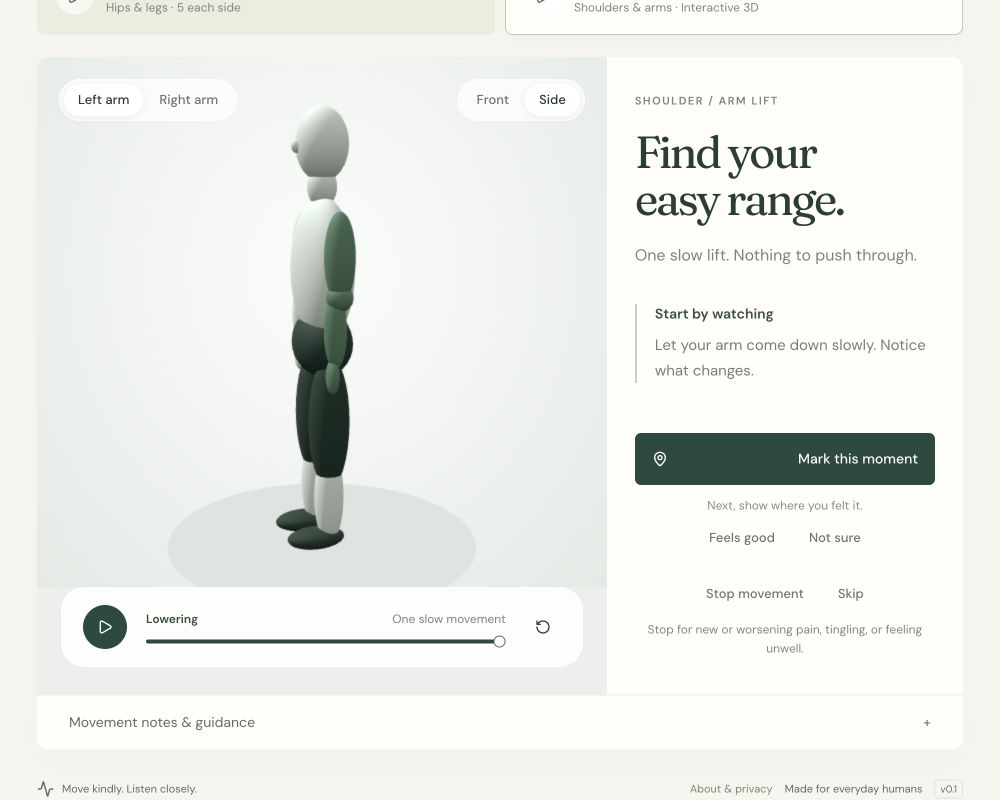
Choose a body location, watch a shoulder movement, pause at a moment and record an observation. The anatomical reference and the movement figure serve different purposes: one locates the observation, while the other provides a repeatable demonstration.
The interface offers selectable anatomy, camera controls, keyboard controls and a simpler front/back map. Separating location from movement phase keeps the journal specific without suggesting that the animation measures the user’s own motion.
Technology and demonstrated result
The prototype uses React, TypeScript, Vinext/Vite and Three.js. The handoff records 738 selectable anatomical structures and a working local journal flow. Browser checks covered phone-size layouts; physical-phone performance remains to be tested.
Entries stay in the current browser’s local storage. JSON export provides a backup, but there is no import or synchronization. Local storage is not encrypted and can be cleared or read by someone using the same browser profile.
Limits
This is a deterministic interaction prototype, not an adaptive coach, diagnosis or clinically validated rehabilitation product. Screenshots show fictional observations. There is no public hosted-demo invitation or claim of health improvement.
The next question is whether people can complete an observation and later find the record useful.
Anatomy attribution
BodyParts3D © The Database Center for Life Science, CC BY 4.0, adapted through Human Atlas into Move Kindly’s skeletal, muscular and connective subset. Geometry was simplified and repacked, coordinate conventions converted upstream, and display colors adapted. The journal’s region labels are approximate. The reference anatomy does not represent all human variation. Original dataset and license.